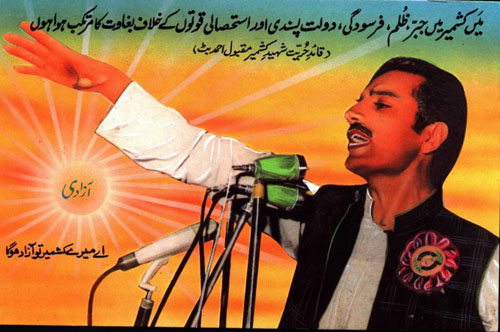
Maqbool Butt was born on 18th February 1938 to a peasant
family in Trahagam village Tehsil Handwara, district Kupwara. His father was
called Ghulam Qadar Butt. All we know about his mother is that she died when
Maqbool Butt was 11 years old pupil in the village's primary (junior) school.
He had a younger brother Gulam Nabi Butt. As per traditions Ghulam Qadar
married again to provide mothering for his children. From second wife he had
two sons, Manzoor Ahmed Butt and Zahoor Ahmed Butt and three daughters. The
early years of Maqbool Butt's life, like thousands of other Kashmiri children
were shaped by the harsh living conditions that characterised the life of
peasants at this juncture of Kashmir history.
It was the feudal system in the Maharaja's Kashmir
that forced Maqbool Butt to participate in the first political action in his
life long struggle against suppression, occupation and for equality, freedom
and social justice. Telling this story on 12 April 1972 from Camp Prison Lahore
in a letter written in reply to Azra Mir, the daughter of veteran Kashmiri
political activist and intellectual, G.M. Mir who was in prison with Maqbool
Butt in relation to the hijacking of an Indian plane 'Ganaga', Maqbool Butt
wrote:
It was 1945 or 1946 when I was eight or nine years old
child. At this time Kashmir was ruled by the
Dogra Family and the entire Kashmiri nation was living a life of slavery. One
of the many forms of slavery is called feudalism. The feudalism gets
established when the king allocates pieces of land to few people. Because these
are loyal to the king and help him in suppression and oppression of his
riyahaya (subjects) so they are made owner of large landholdings for their
services. These landholdings are called their jagirs; estates. The Jagirdars;
feudals neither plough nor sow in these lands. They do not put any labour in
the land. Ploughing, sowing and producing the crops are the jobs of the kisans;
peasant. All Jagirdar does is that when the crops are ready he appears in the
fields and takes all the produce away leaving minimal for the kisans. The Dogra
rulers also had appointed jagirdars in our country. The peasants did all the
labour but the owners of the lands and their produce were these very jagirdars.
The owner of our regions' lands was a Jagirdar by the name of Dewan. Although
we never seen this jagirdar but his agents who were called Kardars( literally
mean 'making others work) used to collect grains and fruits from the peasants.
In the year this incident happened most of the crops were destroyed by the bad
weather. Therefore the produce was next to nothing. Because of the low produce
the peasants were not able to provide the jagirdar as much anaj;grains as they
used to provide previously. On this the Kardars of Jagirdar started harassing
and beating up the peasants in the entire region. They raided the houses and
grain stores of the poor peasants and lashed them. But what did they have to
give for Jagirdar? When the required amount of grains could not be collected
the Jagirdar himself came to our village in his motorcar. This was the first
time that a motorcar came to our village and we were astonished to see it. The
peasants of our village got together and pleaded before the jagirdar for some
concessions. They told him in details the reasons for low production. But he
was not prepared to believe the peasants. He was persistent that, what come
may, even if the children of peasants had to go hungry, his share of grains
must be arranged. He also strongly advised his agents, kardars to complete the
collection at any cost. These Kardars knew well that peasants did not have
anything left to give to Jagirdar but how could they deviate from his orders?
At the exact point when Jagirdar was about to get in his car after issuing the
instructions, all the village children were told to lie down in front of the
jagirdar's motorcar. The Kardars were part of this plan. Therefore when
hundreds of children laid themselves down in front of the jagirdar's car he was
pleaded either to stop the further collection of grains or crush these starved
and naked children under his car. I was also amongst these children and
remember till this day that great big hue and cry. The children as well as
elders, all were crying knowing that once the jagirdar left the village without
writing off the further collections, the peasants will have to face the
qiyamat; the day of judgement. At last the jagirdar seeing the hue and cry of
the naked and hunger worn yellowish children agreed to make some concessions.
Not too long after this incident Maqbool Butt found himself
at the centre of another successful action against the institutionalised
inequality. While the land was granted to the tiller soon after the rise of
Sheikh Abdullah to power in 1949, many practices of inequality carried on. One
of the most explicit manifestations of the class and status based inequalities
was observed in the schools' annual award ceremonies. Here the relatively rich
children and their parents were used to sit on one side and those of poor
background on the other. One year when Maqbool Butt was also amongst the high
achiever he refused to receive the award unless the seating arrangements were
changed. He said that all the children should sit together on one side and all
the parents on the other. As a result the suggestion was accepted and since
then was made norm in this village school. While still in school Maqbool Butt
also successfully led the campaign for promoting this school from primary to
secondary status.
After completing his secondary school certificate, Maqbool
Butt moved on to St. JosephCollege in Baramula. This
was a private missionary college. Here he gained his first degree (BA) in
history and political science.
Answering to a question about his college days from 1954 to
1958, in an interview with weekly 'Zindgi' (life) after the Ganga Hijacking in
1971, Maqbool Butt said:
"I was a good speaker. Used to do lots of strikes. Like
most of Kashmiri citizens we also had great interest in Plebiscite Front. From
the start we had a clear aim before us. One benefit of our strikes in college
was that the government took over the control of the college".
Khawaja Rafiq in his 'Safeer e Hurriyat' (the ambassador of
liberation) writes that listening to the passionate and enthusiastic speeches
of Maqbool Butt, the college principle Father Shankas (could not work out the
correct spellings due to the name given in Urdu only) said:
"This Youngman, if managed to pass through the
hardships, will become a great person. But these types of people usually face
extreme difficulties in the society. The kind of freedom this type of
youngsters demand is very hard to achieve. Subsequently, they get sacrificed on
their way to freedom".
The journey on that road to great sacrifice for Maqbool Butt
was started while still a student at St.
JosephCollege.
Responding to a question about crossing over to Pakistan in the above interview
that was recorded in room number 26 of Mujahid Hotel International, Maqbool
Butt said:
Recalling his migration from one part of Kashmir
to the other in an interview with weekly 'Zindgi' (life) after the Ganga
Hijacking in 1971, Maqbool Butt said:
In December 1957 the release of the lion of Kashmir (Sheikh Abdullah) initiated a chain of agitation
activities. I had my B.A's exams in March/April that year. The examination
centre was in Srinagar.
The arrests of freedom fighters were also started at the same time. My last
exam was on 2nd of April and Sheikh was rearrested on 27th. Student activists
were chased and arrested. I was also an obvious target. Therefore, I went
underground. After three months when the result came, I asked my father to go
and bring the 'temporary certificate'. Then we came to Pakistan in
August 1958. First we came to Lahore but then in
September 1958 settled in Peshawar.
In this journey that changed his life course forever Maqbool
Butt was accompanied by his uncle Abdul Aziz Butt.
First and foremost problem before Maqbool Butt in Pakistan was to
continue his education and at the same time find a job to meet the expenses.
For with out that "it was hard to live in Pakistan'. Therefore, I joined
'Injam' (end/conclusion/performance), a weekly magazine, as sub-editor and
started my working life as a journalist. I did my MA (from Pehswar university)
in Urdu literature and worked with 'Anjam' till the start of full time politics
in 196 (Khawaja, 1997). Meanwhile his marriage was arranged by his uncle with a
Kashmiri woman Raja Begum in 1961. He had two sons from this wife, Javed
Maqbool born in 1962 and Shaukat Maqbool in 1964. In 1966 he married to a
school teacher Zakra Begum and had a daughter Lubna Maqbool from her.
Politics
In 1961 Maqbool Butt contested and won the Kashmiri diaspora
seat from Pehsawar, Pakistan
in the 'Basic Democracy' elections introduced by the then president of 'Azad' Kashmir, Khurshid Hassan Khurshid, commonly known as K.H.
Khurshid. Soon after that he campaigned for K.H. Khurshid in presidential
elections and for GM. Lone in the KashmirState council elections.
Both of the candidates came out victorious on their respective positions. But
when PakistanKashmir to capture Kashmir Maqbool Butt said farewell to
the 'election' politics and offered his services to the Pakistani authorities
but was rejected. This incident had radical affects on the political approach
of Maqbool Butt. At this point there existed in Pakistan a 'Kashmir
Independence Committee' (KIC) formed on 12th May 1963 by middle class Kashmiri
activists including journalists, students, businessmen and lawyers to oppose
the proposals by the Pakistani and Indian foreign ministers for dividing
Kashmir on communal basis. This committee was headed by the Kashmir State
Council member GM Lone who few years back Maqbool Butt campaigned for. After
the end of India Pakistan talks without any conclusion the committee also
became inactive. started the
operation Gibraltar by sending militants across the Indian occupied
Meanwhile inside 'Azad' Kashmiri a 'United Front' of various
political groups, voluntary organisations, shopkeepers associations and intellectuals
got together to resist the construction of Mangla Dam paved the way for
pro-independence politics. In April 1965 the political activists from 'Azad'
Kashmir and members of KIC got together and crossed into Suchetgarh, a Kashmiri
village inside the Indian occupied areas of Kashmir near the Pakistani city of
Sialkot, and formed the 'Jammu Kashmir Plebiscite Front here after PF. Maqbool
Butt was elected as Publicity Secretary for this first pro-independence
political organisation of some significance in 'Azad Kashmir' that later gave
birth to most of the pro-independence groups on the Pakistani occupied side of
the division line including Jammu Kashmir National Liberation Front (NLF)
headed by Maqbool Butt and Jammu Kashmir Liberation Front (Britain) led first
by Abdul Jabbar Butt and later by Amanullah Khan and Yasin Malik. Abdul Khaliq
Ansari, the veteran pro independence voice in 'Azad' Kashmir,
and Amanullah Khan, now the head of JKLF (A) were elected president and general
secretary of PF respectively.
This was the time when several national liberation struggles
were echoed across the world. Maqbool Butt along with many Kashmiris in PF was
also very much inspired by these struggles particularly those in Algeria, Palestine
and Vietnam.
According to Amanullah Khan, a proposal to adopt armed struggle as an objective
of Plebiscite Front was presented before the working party meeting of PF on
12th July 1965 in Mirpur but was defeated. However, Maqbool Butt, Amanullah
Khan, Mir Abudl Qayyum, a Kashmiri migrant from Jammu settled in Pakistan and a
middle class businessman, and Major (R) Amanullah from Highhama town of Kashmir
who fought in the world war and served in the Indian National Army of Subash
Chandar Bose and also participated in the Azad Kashmir war of 1947, secretly
formed 'The Jammu Kashmir National Liberation Front' (NLF) on 13th August 1965
at the residence of Major Amanullah in Peshawar. The aim of this organisation
was written down in just one sentence, "including armed struggle using all
forms of struggle to enable the people of Jammu Kashmir State to determine the
future of the State as sole owners of their motherland"
For the next ten months the group of four recruited more people into the ranks
of NLF including GM Lone (the vice president of PF) and on 10th June 1966 the
first group of NLF members secretly crossed over to the Indian occupied
Kashmir. Maqbool Butt, Aurangzeb, a student from Gilgit, Amir Ahmed and Kala
Khan, a retired subedar (non commissioned officer from AJK force) went deep
into Valley while Major Amanullah and subedar Habibullah remained near to the
division line. The former were to recruit Kashmiris in the IOK into NLF while
the latter were responsible for training and weapon supply. Maqbool Butt along
with three of his group members worked underground for three months and
established several gorilla cells in IOK.
However, after about three months the Indian intelligence
services found out about the underground activities and started a big operation
to capture these activists. In an encounter with the soldiers one of the NLF
members Aurganzeb from Gilgit got killed and Kala Khan received injuries.
Eventually Maqbool Butt and two of his comrades, Kala Khan and Amir Ahmed were
arrested. Commenting on this incident later Maqbool Butt said that this was not
a staged operation. "We were still in organisational phase and were not
fully prepared for taking the risk of clashing with authorities. The risk of
clash should only be taken when you are able to invite the enemy for that. We
were arrested and tried. The government of the occupied Kashmir
wanted the case to be dealt in a military court and finish us off. But the case
was heard in civil court for two years (Khawaja op. cit. p.248). The verdict
was given in August 1968. We were three people in total. Two were given death
(Maqbool Butt and Amir Ahmed) and one (Kala Khan) life sentences. Our comrades
from the occupied Kashmir were given from
three months to three years. Nearly three hundred people were arrested
including students, engineers, teachers, contractors, shopkeepers and
government employees. They belonged to all parties including Plebiscite Front,
Congress, and National Conference etc.
Soon they started planning escape from the prison and within
a month and half managed to escape from the prison in Srinagar. Maqbool Butt later wrote in great
detail about the escape and submitted that before the Special Trial Court in
Pakistant where he was tried along with other NLF members for 'Ganga' hijacking. However, only a brief account of the
escape is included here from one of his interviews:
"On 22nd October 1968 we started planning to escape
from the prison and after one and a half month of intense planning we managed
to put this plan to practice on 8th December 1968 at 2:10 am by breaking the
prison wall. Two of us were on death sentence and the third one with us was a
prisoner from Azad Kashmir. It took us 16 days to reach to the first border
check post of Azad Kashmir. We reached to Muzaffarabad on 25th December and were
interrogated in the interrogation centre of Muzaffarabad till March 1969".
Answering a question about their arrest in Azad Kashmir,
Maqbool Butt said:
"What can I say about that? It was the government of
Ayub Khan (in Pakistan)
and what can I say about Ayub Khan. This man neither had the welfare of the
Pakistani people at his heart nor of the Kashmiris. His government been very
cruel to us. I was severely tortured while in the concentration camp. The pain
increased with the thoughts that this was inflicted by our own (Khawaja op.
cit. p249).
They were released on 8th March 1969 when PF, NLF and
National Students Federation (NSF) activists staged demonstrations in Islamabad. In November
1969 the annual convention of Plebiscite Front was held in Muzaffarabad where
Maqbool Butt was elected as its president.
While recognising the set a back of the premature exposure
of NLF in the IOK, Maqbool Butt was of the opinion that the above incident
inspired and motivated more Kashmiris to join the armed struggle. Explaining
this point in the above interview he says 'now we have entered in a new phase.
Not only are we able to speak in the language of power that is the only
language India
understands but also are able to make the world community, which has ignored our
existence, to recognise us. In this world you have to have your existence
recognised. We have our existence recognised and we will rest only when the
existence of the entire Kashmiri nation is recognised, Inshallah. (op. cit.)
After being elected as the president of PF Maqbool Butt
spent next few years in campaigning for the political rights in Gilgit
Baltistan and 'Azad' Kashmir. The focus of
campaign on this side was the 1970 Azad Kashmir Act that turned 'Azad' Kashmir
a colony of Pakistan,
ruled through the Ministry of Kashmir Affairs and the Chief Secretary. This Act
also reduced the 'Azad Kashmir' to 4500 Square miles area and separated it from
the rest of the state of Kashmir. With Gilgit
Baltistan the situation was even worse. These parts of the State were directly
controlled by Pakistan
through a political agent. The PF launched a week long activities to highlight
this situation and announced that next convention of PF will be held there.
During this week PF activists including Maqbool Butt, Khaliq Ansari, Mir
Qayyum, Amanullah Khan and GM Mir were arrested and forcefully exiled from the
State boundaries.
The event that brought Maqbool Butt and the Kashmir Issue in
limelight in Kashmir, South Asia and at international level was the hijacking
of an Indian Fokker plane 'Ganga'. There are
several official and common theories about the background and impacts of this
hijacking which can not be discussed in the scope of this article. Therefore
only a brief account is presented below.
Ganga, an Indian airliner was hijacked on 30 January 1971 at
1305 hours while on its routine flight from Srinagar
to Jammu. In
total it was carrying 30 people including four crew members. The Hijackers were
two young Kashmiris Hashim and Ashraf Qureshi. They brought the plane to Lahore airport and
demanded the release of about
two dozen political prisoners of NLF in the Indian prisons.
On February the 1st 1971 all the passengers and crew were sent back to India via Amritsar
and the 'Ganga' was set on fire. This incident
was later used by India to
suspend the overflights of Pakistani aircrafts over Indian
Territory (Lamb, 1991, p.289). This situation later led to the
1971 war between India and Pakistan and the creation of Bangladesh. The
hijackers and Maqbool Butt under whose instructions hijackers said the
hijacking was carried out firstly praised as heroes and freedom fighters but
then they and hundreds of other members of NLF were arrested, interrogated in
Shahee Qila Lahore and 'Dulahee Camp' Muzafrabad. Later six of them were tried
in a Special Court of Pakistan under the charges of collaboration with the
Indian intelligence services. They were Maqbool Butt, G.M. Lone, Mir Abdul
Qayyum, Mir Abdul Manan and the two hijackers Hashim Qureshi and Ashraf
Qureshi.
According to Khawaja (p.132) Maqbool Butt was charged under
the 'Enemy Act 1943' of the Indian Penal Code. Ironically he was tried under
the same colonial Act by the Indian Government in 1966 in the Indian Occupied
Kashmir. The case started in December 1971 and after a long trial in which 1984
prosecuting and 1942 defence witnessed were called was concluded in May 1973.
All but Hashim Qureshi were cleared of all charges other than dealing with arms
and explosives etc. Hashmim Qureshi was sentenced for fourteen years imprisonment.
The long statement Maqbool Butt submitted for this case is perhaps the most
detailed reflection of his political ideology. While itcannot be incorporated
in the scope of this article, a brief quote from this statement would not be
out of place here:
"I can say without any hesitation that I have not
designed any conspiracy nor have I been a part of any group of conspirers. My
character has always been transparent and unambiguous. However, I have done one
thing and that is the rebellion against ignorance, greed of wealth,
exploitation oppression, slavery and hypocrisy. If the ruling class of Pakistan that
is a product of imperialis
m and represented by the bureaucracy and military
dictatorship of this country views this as conspiracy then I have no hesitation
in accepting the charge".
It will be interesting to note here that Ganga Case was
carried out under special presidential orders of the then president of Pakistan
Yahayaha Khan according to which the accused were denied the right to appeal
against the decision of this Special
Court. Despite many requests and protests in Azad
Kashmir and Pakistan the
right to appeal for Ganga accused was not
accepted. According to Mitr Qayyum, in a conversation with the founding
president of PF and veteran Kashmiri independence activist Abdul Khaliq Ans
ari who is also a renowned lawyer in 'Azad Kashmir', the
then law minister of Pakistan Mehmood Ali Qasuri said 'where in the world do
you have the right to appeal against the Supreme Court decision?'. In response
Khaliq Ansari asked 'and where in the world the Supreme Court has ever been
used as 'Trial Court'?
According to Mir Abdul Qayyum, the right to appeal was
restored only after the British Kashmiris warned several Pakistani ministers on
their visits to Britain
that the unlawful tactics of the Pakistani rulers to convict these Kashmiris
will be exposed (Mir Qayyum, unpublished documents of NLF). Using this right
NLF filed appealed against the Special
Court's decision about Hashim Quereshi. But it
took seven years before this appeal was heard at Supreme Court where Hashim was
also cleared (Khawaja op. cit. p.151
).
In terms of Kashmir, the 'Ganga'
trial had many far reaching affects on the NLF and on the wider independence
politics. Firstly it affectively paralysed NLF who lost many members due to
physical torture, psychological pressure and financial losses. Many also became
disillusioned and disappointed due to various misunderstandings that were
developed between the leadership during the course of trial. Maqbool Butt
however continued his efforts to reorganise the struggle in both the armed and
political fields. In 1975 the PF decided to participate in the elections held
under the Bhutto's Peoples Party Government. Maqbool Butt who at this point had
no office responsibility in PF also contested the election. All PF candidates,
including Maqbool Butt, lost to PPP candidates. The PF commentators claim that
the result had a lot to do with massive vote riggings in favour of PPP
candidates.
With NLF dismantled and PF demoralised, Maqbool Butt once
again crossed over to the Indian occupied Kashmir
against the advice of many of his friends and comrades in May 1976. This time
he went with Abdul Hammed Butt and Riaz Dar. Within few days of crossing they
were spotted and arrested by the Indian forces. In 1978 the Indian Supreme
Court restored death sentence on M
aqbool Butt and he was transferred to Delhi's Tihaar Prison. After eight long years
in prison Maqbool Butt was hanged on 11th February 1984 while the legal team
was waiting for Maqbool Butt's case to be reopened on the grounds of flaws in
the trial that convicted Maqbool Butt of murder. His execution was carried out
in haste to avenge the killing of an Indian diplomat in Birmingham by an unknown group 'Kashmir
Liberation Army'. Rovendra Mahatre was kidnapped in the first week of February
1984 from his Birmingham
office by KLA who demanded among other things the release of Maqbool Butt. Thus
was ended the life of one of the greatest revolutionary of modern Kashmiri history
and was born what Kashmiris remember as Shaheed e Azam (the greatest martyr).
Ironically, death warrants of Maqbool Butt were signed by Dr Farooq Abdullah
the then Chief Minister of IOK who spent several days with Maqbool Butt in
'Azad' Kashmir and Pakistan
in 1974 and who said later that 'I have found Maqbool Butt a very romantic man,
just like Che Guevara. He could have added 'like Shiekh Abdullah in 1930s',
whose politics initially inspired Maqbool Butt as a student at St JosephCollege. India
is acclaimed by the democratic world as the largest democracy on earth. While
there is no doubt that democratic traditions and institutions in India are far
more established, when it comes to Kashmir India is no more than an occupier
and oppressive state that rules Kashmir through colonial like structures and
authoritarian means with little regards for the democratic values, human rights
and civil liberties. This neo-colonial face of Indian rule
in Kashmir was demonstrated in its worst form
in the way Maqbool Butt was hanged and what followed.
Not only that Maqbool Butt was executed in revenge, no one
was allowed to see him before execution and he was buried inside the prison
premises after execution. Maqbool Butt's sister says 'we went at the Srinagar airport to catch flight for Delhi but the police did not let us go'. His
niece tells 'they did not return any of his belongings from Thiar'. I wish they
let us have some soil from his grave in the prison'
Mohammed Yasin Butt another Kashmiri who was imprisoned in Tihar for his
involvement in freedom struggle wrote to 'Kashmir Tim
es' Britain
in 1995 that during his time in Tihar prison he spoke to several prisoners and
prison staff about Maqbool Butt. They all remember him with great respect for
his dignified behaviour and for his struggle in prison for the rights of
prisoners and the lower rank prison staff. He further wrote:
"Maqbool Sahib's grave is the only one in Tihar prison which has a wall built
around it by the prisoners. Every month prison staff cleans it and prisoners
light fragrant candles on it and pray for him according to their own
faiths".
Despite the confidence building measures and ceasefire between the Indian and
Pakistani armies in Kashmir the repeated
demands by Kashmiris for the return of Maqbool Butt's remains are not responded
to and this icon of Kashmiri liberation struggle is kept in prison even after
his execution. The only other example of this kind of disregard for human
rights of political activists comes to mind is
that of Baghat Singh, Sukh Dev and Raj Guru whose bodies
were also not returned to their families by the British colonial authorities
after execution.
Last year Iftikhar Gilani, a Delhi based Kashmiri journalist who spent ten
months in Tihar wrote in his book that Maqbool Butt's grave in prison has been
built over. There are two other graves waiting for the body of Maqbool Butt.
One in the martyrs' cemetery in Srinagar's
old Eidgah district where its tombstone has inscription in green Urdu letters
that read "this is where Shaeed e Azam[ (the great
est martyr) Maqbool Butt will one day be laid to rest'.
Another grave for Maqbool Butt is between the graves of his brothers in the
courtyard of the house where he was born in Trahagam.
This unique situation about the burial of Maqbool Butt was nicely depicted by
Mohammed Yamin, a Kashmiri poet from 'Azad' Kashmir in his poem 'Roashni Ka
Shaeed e Awal' (the first martyr for the light) that is now juxtaposed on a
large portrait of Maqbool Butt and hangs on the front room walls of many pro
independence Kashmiris across AJK and diaspora from this part of Kashmir.
Twenty two years on, since Kashmir's first dreamer for an
independent Kashmir was sent to the gallows, his dream, his prophecy and his
legacy lives on, comments
While the political scene on both side of Kashmir changed
dramatically after that fateful February day in 1984 - when Kashmir's little
known revolutionary was hanged in India, his hanging changed the fate and for
tunes of Kashmir. That
momentous change which evolved into an armed revolution has meant that the
issue of Kashmir is not going to be brushed
under the carpet until his mission is complete. He is now known as the
Shaheed-e-Azam, 'father of the nation'. He has become an icon for countless
political groups both within and outside the vale of Kashmir.
11 February is being commemorated as Maqbool Bhat's 22nd
death anniversary. On this day the scene was set to make a modern day legend
for Kashmir. On this day Kashmiris remember
their hero with honors and pride. Kashmiri nationalist groups, on both sides of
the dreaded line of control and all over the world, remember him well but his
adversaries who had hoped that he would
be forgotten with the passage of time wish their nightmare
was over. Born after his death, young men of age 22 who have grown up with the
only undisputed name in Kashmir's turbulent
history are not likely to forget his dream and his mission. That name will live
on for centuries to come.
It was well after his hanging in February 1984 that
politically disillusioned and desperately dispassionate young men began to walk
down the never ending road to sacrifices. That emotionally charged and
compassionately fuelled armed conflict, which later became symbol of liberty
for JKLF and was referred to by Indians as 'fanaticism' - of the kind never
witnessed in the recorded history of Kashmir – was in fact Maqbool Bhat's path
for liberation of his homeland. He is thus called the real architect of that
innovative and dangerous dimension to the conflict – the armed revolution.
Kashmiris call it a freedom fight. The freedom fighters of Kashmir have gone on to make new history. Centuries of
injustices, decades of political subterfuge and years of incarceration finally
reached saturation point. One martyr proved enough for Kashmir to set alight
its unique history and an entire era of peaceful struggle into violent uprising
that continues to haunt both New Delhi and Islamabad with dangerous
connotations for the entire region.
Dozens of books, newspaper articles and research documents have been written on
the subject seeking to establish the root cause of change in Kashmiri ethos.
Every year on this day, we are reminded of the root cause and the reasons. The
reason lies in an obscu
re grave in New
Delhi's back yard – the Tihar Jail, and lives in
Kashmiri hearts.
He will remain a symbol of real strength and mark of respect in a dynamically
changing but forcibly divided Kashmir. He was
controversial in his time. He laid down his life in controversy but 22 years
are a convincing account of the fact that his words should have been listened
to more carefully with due attention. Those who labeled him as an enemy agent
in Pakistan and those in India who regarded him as a dreaded terrorist
with a mission from Pakistan
now hang their head in shame.
At the time, in Kashmir, very few knew the
truth about him. After his death, everyone (both in India
and Pakistan as well as in Kashmir) wanted to know the truth. The truth, which had
long become a casualty in the Kashmir saga in
terms of India-Pakistan politics of deceit and war of words over who should
rule his homeland, is still a rare commodity. Both the governments spend
millions to simply fund those who play a role in disguising the truth to the
benefit of one or the other. Truth is fiercely suppressed in Kashmir
as ever.
Is India
really so much frightened of the truth that they refuse to handover his mortal
remains after 22 years of his
death? What then is the explanation for this refusal and why
desecrate his grave? Why then the most liberal and unorthodox writers of India have not
set out to discover the truth as yet? Many Indians who have taken the trouble
to write on the issue of Kashmir post-1990 have conveniently ignored the entire
chapter except for passing references to Maqbool Bhat – with the exception of a
couple of stories.
The valley based newspapers (and some in Rawalpindi
- circulated in Azad Kashmir) have been publishing special numbe
rs on his death anniversary but other popular papers in
Jammu-Kashmir and in India
and Pakistan are yet to come
to terms with the fact that this was an extraordinary man who had a vision for
the future of Kashmir.
His ideas clearly clashed with the official view regarding the future of
Jammu-Kashmir. It is not surprising that attempts have
been made to undermine his image and popularity within the
official circles. He wanted independence. He saw independence for Jammu-Kashmir
as the only solution.
The fact that he consciously chose to lead his political life on a collision
course with the establishment of the day which consequently brought him closer
to death is a testimony of his integrity that makes him stand above the rest of
the martyrs of Kashmir.
He is still buried in Tihar jail but continues to command his people in the
streets of Srinagar
to Sopore, from Muzafarb
ad to Mirpur. He has achieved after his death what he could
not achieve during his life but the banner waving and placard carriers of Kashmir's younger generations need to comprehend his
message and unravel his approach against today's intriguing complexities.
He is likely to continue to command respect and prestige in the ranks of
Kashmiri freedom fighters and independence campaigners for many years to come
but the JKLF and other Kashmiri nationalist groups, which espouse to follow in
his name have got to put up a united front against the diversion of road maps,
increasingly paralyzing peace formulae and hegemonistic designs to divide and
rule Jammu-Kashmir for ever.